Food Choices
The Plate as a Weekly Pattern of Intention
Field observations on how the rhythm of weekly food choices shapes weight awareness and builds lasting nutritional habits over time.
Read Article →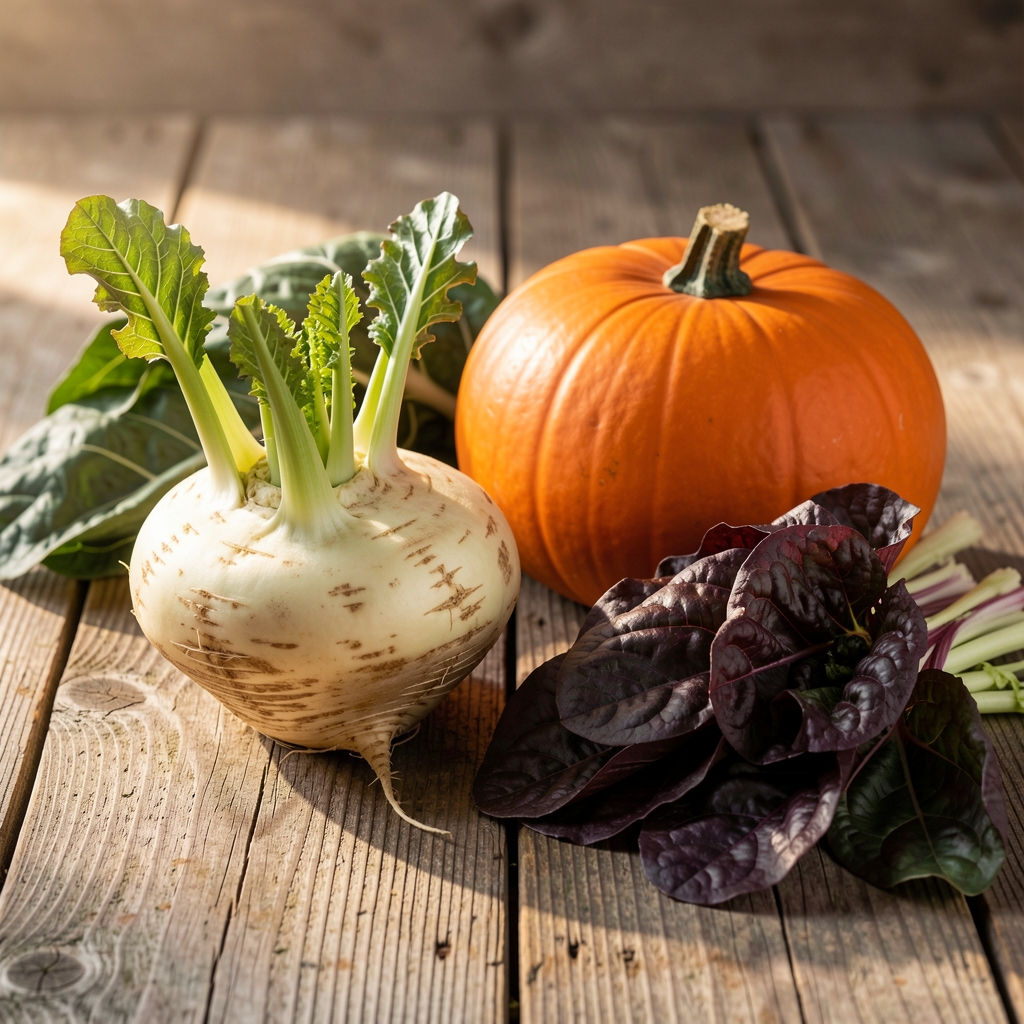
There is a particular congruence between the autumn produce calendar and the conditions under which weight balance tends to settle into something sustainable. Root vegetables, brassicas, squash, and the deeper greens of October and November are not, in themselves, exceptional nutritional instruments. But they arrive at a season when cooking from scratch becomes, for many people, a more natural instinct — and it is in the act of cooking, rather than in the specific properties of any ingredient, that much of their value resides.
Seasonal produce has a structural effect on the diet that goes beyond its nutritional content. When a particular vegetable is abundant, affordable, and visually prominent at the market, it exerts a kind of gravitational pull on the weekly shopping list. The appearance of celeriac in autumn does not merely add one ingredient to the pantry; it tends to bring with it a set of preparations — soups, roasted dishes, gratins — that involve slower cooking, more varied vegetables as accompaniments, and, typically, lower reliance on prepared foods.
This effect is more pronounced when a person buys directly from a market or a subscription vegetable box than when they shop from a supermarket, where all vegetables are available in essentially constant supply regardless of season. The constraint of seasonality — the fact that certain things are simply not available, or available only at significant cost — has a focusing effect on food choices that the year-round availability of everything does not replicate.
From a nutritional perspective, the autumn and winter vegetable palette tends to be particularly rich in the dietary fibre that supports a sense of fullness between meals, in the micronutrients associated with energy and general wellbeing, and in the kind of dense, slow-digesting carbohydrates that contribute to more stable energy levels through the day. None of this is a singular observation, but the combination, across several months of regular consumption, tends to leave a visible mark on a person's overall nutritional pattern.
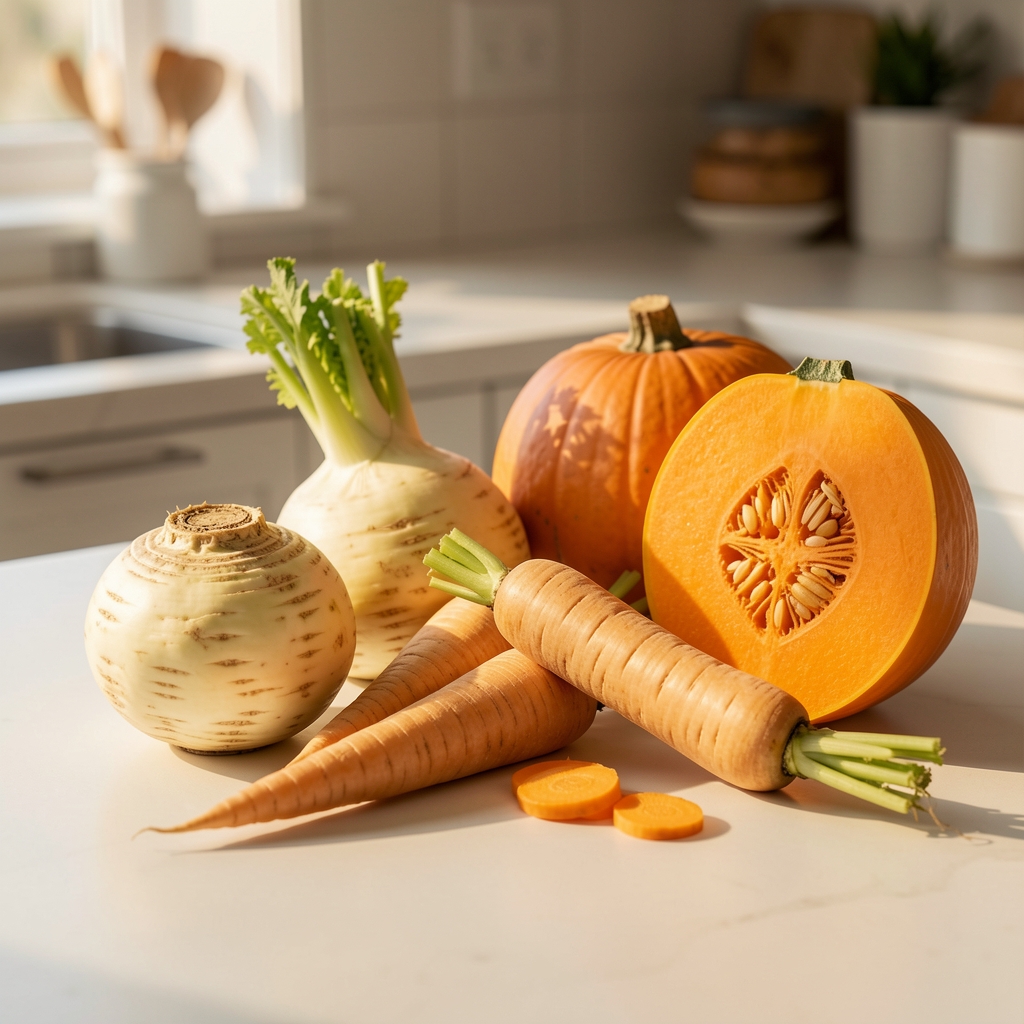
Autumn produce selection, editorial composition — London, 2026
The relationship between plant-based meals and sustained weight balance is a subject of considerable interest in nutrition literature. The evidence, taken as a whole and considered with appropriate care, suggests that a diet rich in plant-based whole foods tends to support a sense of satiety — the feeling of fullness and satisfaction that follows a meal — more reliably than diets of equivalent caloric content composed primarily of processed or refined foods.
The reasons for this are several, and they operate through different mechanisms. Whole plant foods tend to contain more dietary fibre, which slows the passage of food through the digestive system and sustains the sensation of fullness for longer. They also tend to have a lower energy density — that is, a given volume of food contains fewer calories — which means that a person eating to a comfortable level of satiety will, on average, consume somewhat fewer calories over the course of a day than a person eating an equivalent volume of higher-density food.
The autumn and winter vegetable calendar supports plant-based eating in a particularly natural way. A lentil and root vegetable soup, a roasted brassica dish with whole grains, a slow-cooked bean stew with winter greens — these are preparations that involve primarily whole-plant ingredients, that produce large volumes of food with high satiety value, and that require cooking from scratch in a way that builds both nutritional awareness and a more considered relationship with food over time.
"Seasonal eating is, among other things, a form of portion guidance imposed by the calendar rather than by conscious effort — and it is this quality that makes it, for many, more sustainable than approaches that require constant individual negotiation."
Fruit intake in the autumn and early winter months has a particular character. The stone fruits of summer have given way to the harder, denser fruits of the season — apples, pears, quinces, late season plums — which tend to be consumed more slowly, require more chewing, and are less often eaten in quantity. This distinction matters in the context of nutritional awareness, because the pace and volume of fruit consumption is as relevant to its effects on overall dietary balance as the specific nutritional content of the fruit itself.
From a weight awareness perspective, the sugars present in whole fruit behave differently from the equivalent quantity of refined sugar in a processed product, in part because they are delivered within a matrix of fibre that moderates the rate at which they enter the bloodstream. Whole fruit, eaten as fruit, contributes to nutritional variety and energy in ways that are broadly supportive of a balanced diet. The displacement effect is also relevant: a person eating a piece of fruit at a moment of afternoon appetite is not eating something else.
The practical implication is simple: keeping a bowl of seasonal fruit accessible in the kitchen — easily visible, requiring no preparation — tends to increase its consumption at the expense of convenience snacks of lower nutritional density. This is one of the more reliable small structural changes that a nutritionally observant person can introduce to their daily routine, and it is particularly well-suited to the autumn, when interesting and varied fruit is available at reasonable cost.
The dietary year has a shape, and that shape is relevant to weight awareness in ways that are often underappreciated. The spring and summer months tend to favour lighter, more varied eating — salads, raw vegetables, fruit in abundance, reduced cooking effort. As the year turns, the diet shifts toward heavier, more cooked foods, larger portions, and a reduction in raw vegetable intake. This is a natural response to environmental conditions, and it is not, in itself, a nutritional concern.
The question is how the winter diet is structured within this broader seasonal shift. A winter diet rich in roasted root vegetables, legume-based stews, whole grain porridges, and brassicas prepared in a variety of ways can be as nutritionally sound as a summer diet of salads and fresh produce, if not more so in terms of sustained energy and satiety. The variables that most consistently differentiate a nutritionally balanced winter diet from one that is less so are not the season's available ingredients, but the degree to which cooking from scratch is maintained and the degree to which fibre-rich plant foods remain central.
A nutritionist's perspective on this is that the autumn, far from being a period of nutritional difficulty, is among the more natural seasons for building and reinforcing the sustainable food habits that most reliably support gradual weight balance. The ingredients available are varied and nutritionally dense. The cooking traditions associated with autumn and winter produce are, in many culinary cultures, among the most complete from a whole-diet perspective. And the instinct toward warming, home-cooked food that the season naturally encourages is, in nutritional terms, a genuinely useful instinct to follow.
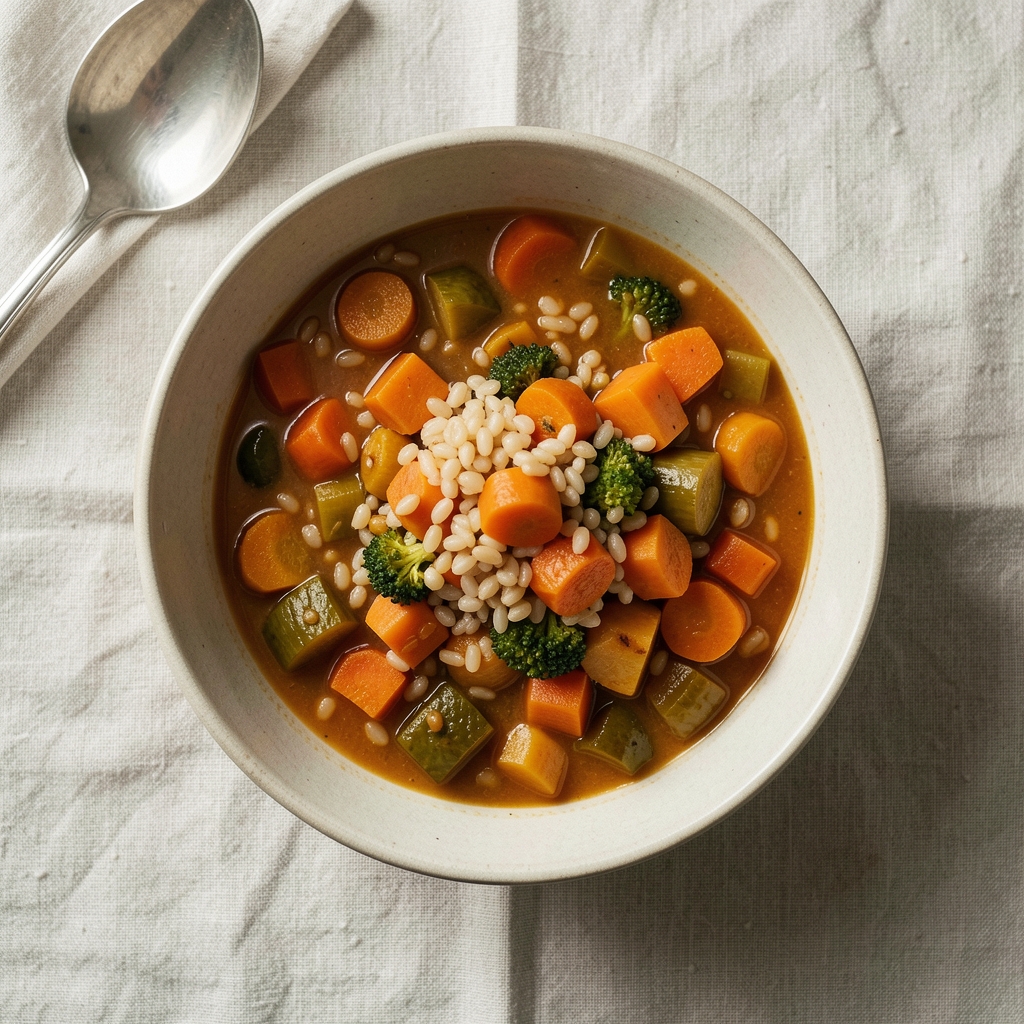
Whole food preparation, home kitchen — London, 2026
Dietary variety — the practice of consuming a wide range of different foods within a given period — is one of the more consistently observed correlates of nutritional balance in the published literature on diet and weight. The mechanisms are not fully resolved, but they plausibly involve the broader coverage of micronutrients that a varied diet provides, the reduced dependence on any single food or food group, and the tendency of varied diets to resist the kind of rigid routines that can become fragile under the pressures of everyday life.
Seasonal produce supports dietary variety in a structural way. A person who consistently buys whatever vegetable is in season will, over the course of a year, have consumed a considerably wider range of vegetables than a person who buys the same half-dozen varieties year-round. This breadth of consumption, observed across the seasons, tends to produce a more robust and nutritionally complete dietary pattern than any specific dietary framework or plan could reliably deliver.
Autumn, in this sense, is not a season to be managed nutritionally. It is a season to be followed — with some attention to cooking from scratch, some curiosity about the produce that arrives at the market each week, and a willingness to prepare it in ways that are unfamiliar. The weight balance that tends to accompany this kind of seasonal eating is not a consequence designed for; it is a natural outgrowth of a way of engaging with food that is primarily oriented toward pleasure, variety, and the quiet discipline of cooking well.

Eleanor Whitfield is the founding editor of Soravena Compendium, writing on the intersection of seasonal food, daily nutrition habits, and the long-term relationship between food choices and weight awareness.
More from this author →Field observations on how the rhythm of weekly food choices shapes weight awareness and builds lasting nutritional habits over time.
Read Article →How daily movement and home cooking intersect in the formation of lasting nutritional habits and weight awareness.
Read Article →